
Photo by David Jones on Unsplash
Somewhere in Italy, a sixteen-year-old is about to sit down to watch the World Cup without his national team in it. He has never seen the Azzurri play in one. Three consecutive World Cups missed. Four all-time titles, level with Germany among European nations, and now this. Italy watching from the sofa while the rest of the world plays.
The usual explanations will arrive on schedule. A bad night in the playoffs. An unlucky penalty. An injury at the wrong moment. These things happened, and they are also, at this point, beside the point. You do not miss three tournaments in a row through bad luck. When I started thinking about Italy’s football collapse, I wanted to understand why a country that once seemed to produce footballers almost as a natural resource no longer knows how to build them.
So I called Adriano Bacconi.
Bacconi is one of the pioneers of match analysis in Italian football. He began working with the national team under Arrigo Sacchi, regarded as one of the greatest managers of all time, during the epic 1994 World Cup in the USA. He later became Head of Match Analysis for Marcello Lippi’s Italy during the victorious 2006 World Cup, and brought tactical analysis to Rai programmes such as La Domenica Sportiva and 90° minuto. Today, he runs Math&Sport, a Politecnico di Milano spin-off that turns match data into tactical tools for Serie A clubs.
I initially interviewed him for a piece in the Swedish news magazine Fokus, but we ended up speaking for almost an hour. Much of what he said could not fit into that article, but it was too good not to share. What follows is our conversation, edited and condensed.
Italy is about to miss another World Cup. When you look at Italian football now, what do you see?
Adriano Bacconi: I see a lot of confusion. The Italian game has become one big minestrone.
The real problem is that there is no Italian model. There is no shared idea of what talent actually is, or what we want to develop. Everyone works a bit on their own, a macchia di leopardo, like leopard spots. You have quality here and there, good work in some places, but nothing that connects it into a system.
Every coach arrives with his own ideas. Sometimes they work, sometimes they don’t. But there is no continuity. The national team does not express a coherent football thought. The players are also affected by this, because they grow up in a fragmented environment.
Some people say Italy should go back to the football of 1982. Others say we should copy Spain, Belgium, Switzerland. But the truth is that today nobody really knows what the Italian model is.
Adriano Bacconi.
You keep coming back to the word “talent”. What does Italian football misunderstand about talent?
Bacconi: The first question should be: what is talent? What are we actually trying to pursue?
Talent is not only technique. It is not just the kid who dribbles past three players at twelve years old. It is perception, decision-making, the ability to read space, the ability to relate to others inside the game.
In Italy, youth football is often abandoned to coaches whose main objective is to win matches at ten or twelve years old. But at that age, the priority should be to understand the player. What does he see? How does he perceive the game? What are his cognitive abilities? Even something like the dominant eye can matter, because it influences what a child sees better and how he reads situations.
Instead, too often we train children as if they were already adults. We teach them to win the weekend match, not to become footballers in ten years.
This sounds like something Italy should have started fixing a long time ago.
Bacconi: It should have. After the 2010 World Cup disaster, Roberto Baggio led a reform project for the technical sector of the federation. I helped write it. It was a huge project. Around 900 pages, but the point was simple: create a model.
It was based on the perceptive and cognitive abilities of young players, on relational play, on technique applied to real game situations. But above all, it was based on forming coaches. Not just coaches in the professional clubs, but teachers and educators across the country, people who could train other coaches on the territory.
The idea was to create value from below. A capillary system. A network that could reach the grassroots level.
If that project had been implemented in 2011, today we would be collecting the fruits.
But it was not implemented.
Bacconi: No. Nothing happened. And not because there were no ideas. The ideas were there. The analysis was there. It was not implemented for political reasons, for reasons of opportunity, for the protection of positions of power inside the federation.
There was no real will to change.
This is often the problem in Italy. Everyone knows what should be done, but change disturbs existing balances. So the system protects itself.
Is part of the problem that Italy’s old football model actually worked?
Bacconi: Of course. Italy won a lot in the past, so there is always the temptation to say: before was better.
And the old Italian football did work. It was based on duels, experience, tactical intelligence, and on knowing how to manage the match. A speculative kind of football, in the technical sense. It gave Italy enormous results.
But that also makes it very difficult to abandon. When something has produced victories, people turn it into a reference point. They say: this is who we are.
The problem is that football has changed.
How has it changed?
Bacconi: Other countries are building players differently. Look at some of the Scandinavian models, for example. They are based on physical development, multi-sport competence, late specialization.
Children do martial arts, swimming, and different team sports. They build the body first. They develop coordination, strength, and perception. Only later do they specialize.
In Italy, we do almost none of this.
We do not have a clear philosophy of work. We do a bit of everything, from the physical to the technical, from the tactical to the cognitive, but without a coherent method. There is also no real relationship between what is taught at Coverciano, the Italian football federation’s technical centre and coaching school, and what happens on the territory. There is no structure that goes from the top all the way down to the base.
So the issue is not that Italian talent no longer exists?
Bacconi: No, the young players exist. The youth national teams prove it.
Italy won the Under-19 European Championship in 2023. But where are those players now? Many are lost. They go to lower divisions, or abroad, because they do not find space in Serie A.
There is a bottleneck between the youth sector and the first team.
The players are formed up to a certain point, but then the system cannot absorb them. At eighteen or nineteen, they are often not ready for Serie A, but if you send them away, to Serie B, Serie C, abroad, you lose control of the most important moment of their development.
How do you solve that bottleneck?
Bacconi: There are two main ways.
The first is regulatory. Create mechanisms that incentivize clubs to use young players, within the limits of European rules. You cannot simply forbid clubs from signing foreign players, because of the free movement of workers. But you can think about rules that encourage the use of academy players or young players developed inside the system.
The second is even more important, which is creating a real bridge between the youth sector and the first team.
This is why B teams are fundamental. They allow players between eighteen and twenty-one to remain inside the club’s environment while playing competitive football. They are still part of your tree, but they are growing in a real championship. You can monitor them, develop them, and prepare them for the first team.
In Spain, this exists. In Italy, there are very few second teams. Three or four. Without that bridge, the development chain ends too early.
You also mentioned that coaches and players should grow together.
Bacconi: Yes, because there has to be methodological continuity.
If a coach works with young players and then moves into the first team, he can bring with him the players he has formed. He knows them. They know his ideas. This is how you create continuity.
Instead, in Italy we often look for the fashionable coach, the famous name, someone who can win immediately. Everything is short-term. The system is not built around a project.
You need to grow coaches from the youth sector too, not only players.
People often say Italian football lacks resources. Do you agree?
Bacconi: Not really. Italy is winning in many other sports. Tennis, volleyball, rugby is improving. Sports where historically we were not always dominant are producing results.
So the problem in football is not simply resources. Football has enormous resources.
The question is where the money goes.
In Italian football, there is no regulatory system that directs the flow of money toward development. A lot of money ends up in salaries, agents, commissions. It does not go into increasing the competence of the people working inside the system.
And often it is easier, more convenient, to buy a young player abroad than to develop one in Italy. That creates a double damage: you send money abroad, and you take space away from Italian players.
Photo by Zach Rowlandson on Unsplash
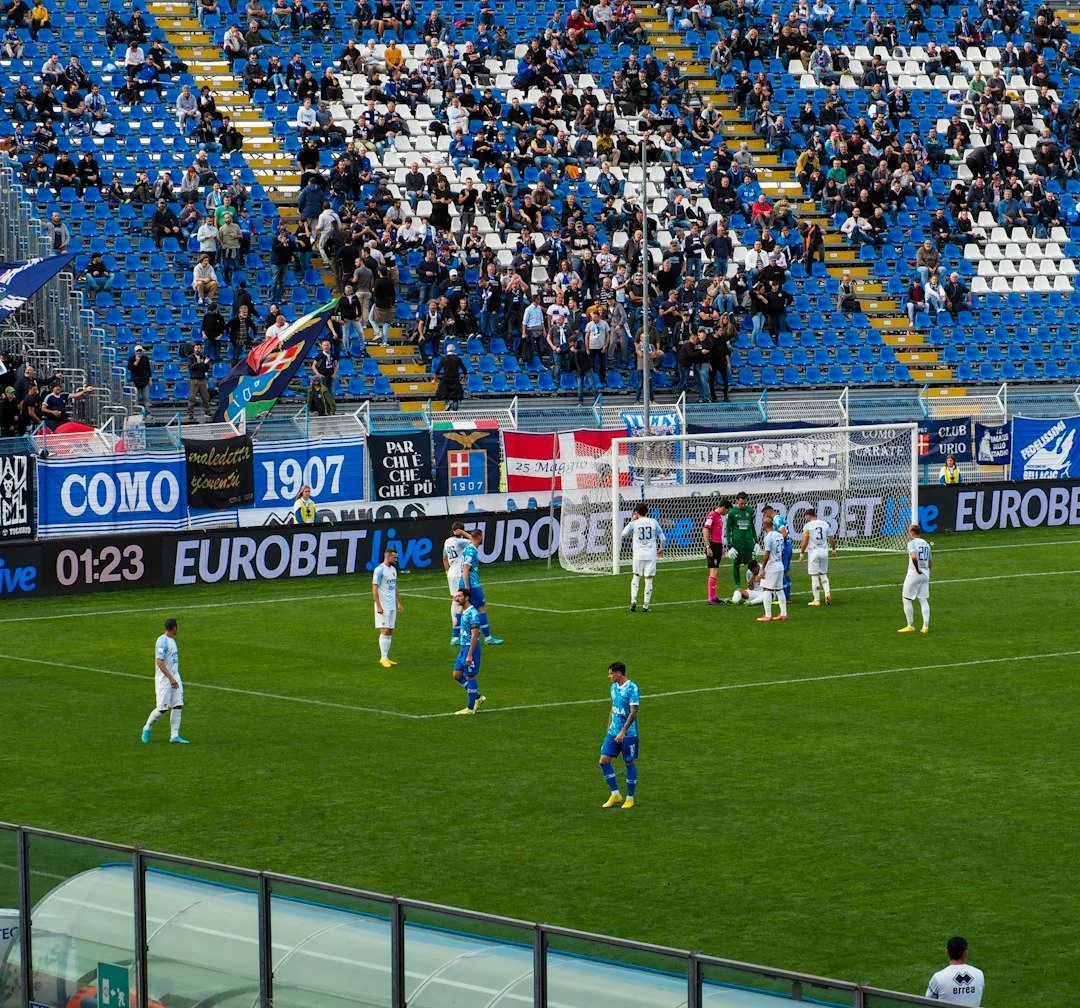
I wanted to ask you about Como, the small club from Lake Como that has gone from the lower divisions to Serie A under Indonesian ownership, with Cesc Fàbregas on the bench and a playing style that looks very different from the Italian tradition. From the outside, it seems like one of the few Italian clubs trying to build a different model.
Bacconi: Como is interesting because it is doing something against the Italian tradition.
At first, the project was different. But as the club moved up from the lower divisions into professional football, they understood that they needed to change model. And they changed it radically.
They invested in technical players who fit a clear playing identity, but who also had potential value. From an economic point of view, players can be divided into two broad categories: stable players and asset players. Stable players are mature and give you reliability. Asset players are younger, in the first part of their career, with a significant value that can grow.
If you look at Como, apart from a few exceptions, they have many asset players. If you look at a club like Inter, you see many stable players. This shows how countercultural Como is compared with many Italian clubs.
Como also has a precise playing identity, inspired by Spanish football through Fàbregas. And that is viewed with suspicion by some traditionalists.
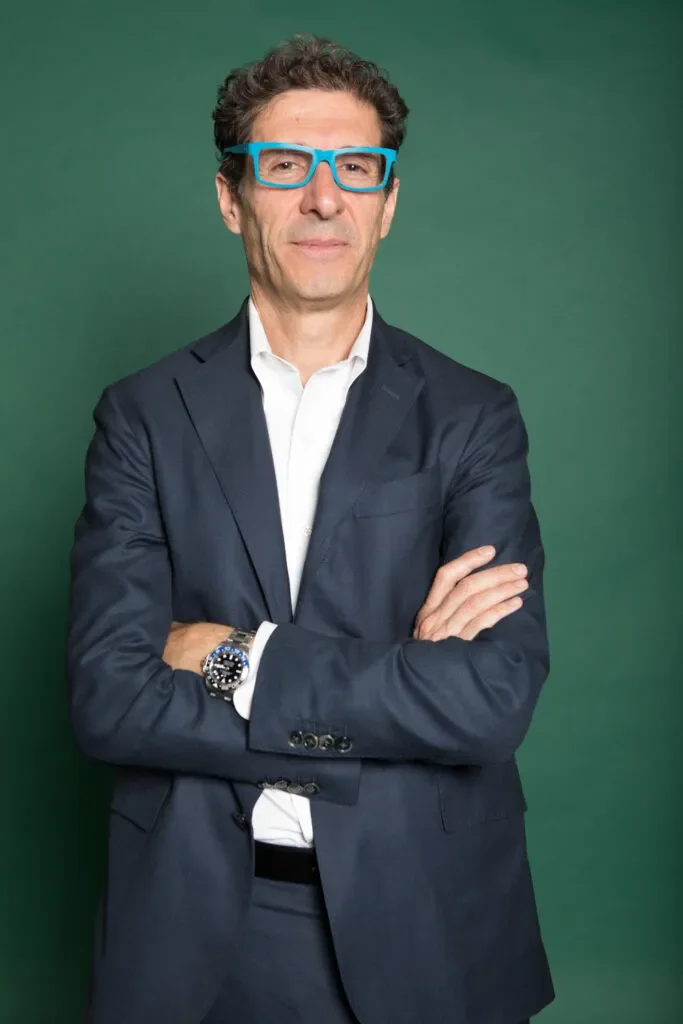
Adriano Bacconi.
Why is there suspicion around Fàbregas?
Bacconi: Because he is foreign. And because in Italy there is still a huge barrier of entry toward ideas that come from outside.
It is strange, because Fàbregas comes from one of the most admired football cultures in the world. He is Catalan, formed in that Spanish football environment. And still, in Italy, there are people who look at him as if he were imposing something foreign.
There is a kind of football prejudice.
But Como is working very well. They are combining short-term results with medium- and long-term objectives. They have made big investments, yes, but in players who today are worth more. And they are building a system.
Can Como also develop Italian players?
Bacconi: That is the interesting part.
If you look at Como’s youth sector, it is largely Italian. They know they are an Italian club. But when they went scouting for the first team, they did not find enough Italian players ready to play in that model.
So what did they do? They brought in players, including Spanish players, who already knew that kind of football, in order to get immediate results and position the club internationally. At the same time, in the youth sector, they are trying to form Italian boys according to that model.
In miniature, they are doing what the federation should do.
Give guidelines to coaches, build a network, make sure there are competences at the lower levels, and create the players of tomorrow.
Your company, Math&Sport, works with data and performance analysis. Is Italian football open to that kind of expertise?
Bacconi: More than before, but still not enough.
Math&Sport is a spin-off of the Politecnico di Milano. We develop algorithms using match data. Cameras record the positions of the players and the ball fifty times per second, and from that we create performance indicators that can be used by clubs.
Some big clubs are now building specialized departments. Inter, Milan, some others. But in Italy, you can count them on the fingers of one hand.
If you go to clubs abroad, the scale is different. At Tottenham, for example, the data department is like a factory. They prefer to develop many solutions internally. In Italy, this culture is still much less developed.
There are good people, of course. But the system is slower.
Why is Italian football so slow to renew itself?
Bacconi: Because it is a closed system.
There is a huge barrier of entry. There is the gender barrier, of course. There is also a strong lobby in favour of former footballers. In Italy, if you did not play football, it is very difficult to qualify for certain roles. If you want to become a coach and you were not a player, you may have to go abroad to do your UEFA course.
This is absurd.
Look at Arrigo Sacchi. The only coach who truly changed the way football was played and trained in Italy never played professional football. So what is the reason for closing the system only to former players, if not caste, lobby, interest?
In Germany, many coaches come from university backgrounds, with specific competences in coaching. Many did not play professionally. In other sports, too, some of the greatest coaches never played at the highest level.
Football should be open to competence. Not only to biography.
You also connect this to school and education.
Bacconi: Yes, because the relationship between sport and school is underestimated in Italy.
In some countries, the public school system helps young athletes. Teachers go to training centres. Timetables are adapted. Sport and education are integrated.
In Italy, if you do sport at a serious competitive level, you often stop studying. Or if you study seriously, you cannot train at the level required.
This is a huge problem.
It reduces the pool of athletes, but also the pool of future coaches, analysts, directors, people who could bring different competences into football. The system remains narrow.
Is Italian football losing its role as the country’s national sport?
Bacconi: Today, the national team is Sinner.
People wake up in the middle of the night to watch what Sinner does in Miami. That tells you something.
Football still has enormous money, enormous visibility, enormous tradition. But emotionally, something has shifted. Italians are following tennis with an intensity that used to belong only to football.
And this is also because other sports are giving people something that football is not giving them.
Are you optimistic?
Bacconi: I was born optimistic. But I am not patriotic. I do not need Italy to win everything. If something smart cannot be done here, and it is done somewhere else, that is fine with me.
Actually, I like defeat. There is much more to learn from losing than from winning.
Has Italian football learned from losing?
Bacconi: Not enough.
The ideas exist. They have existed for years. We do not need to return to the past. And we cannot simply take the Baggio project from 2011 and apply it as it was, because fifteen years is a geological era. The world has changed. Schools have changed. Young people have changed.
But the principles are still valid: build a model, develop coaches, connect the youth sector to the first team, integrate sport and education, open the system to competence, put the general interest above the interest of individual components.
Ultimately the problem is not knowing what to do. The problem is deciding to do it.
