
Stella Scocco reflects on family rituals and how places connect us to time
Civitanova Marche, June
This letter comes to you from Italy’s eastern coast, almost directly across the country from Rome. If the Apennines were not in the way, I suspect the journey would be much shorter. My boyfriend and I have just moved here for the summer, and we are preparing for the rest of my family to arrive and depart in waves over the coming months.
My family has been vacationing in Civitanova Marche for three generations, or, as my dad likes to put it, “a century of Scocco.” By one of those almost unbelievable coincidences, my boyfriend also spent his childhood summers in this region, about a 30-minute drive from here in Montecassiano. The Marche landscape is full of small old towns perched atop hills. There was a practical reason for this. From the hills, you could see potential attackers long before they reached you, and they would have to make their way up first.
The region is known for its shoe factories. A thirty minute car ride from the coast and you will find the factories of Louis Vuitton, Fendi, Loro Piana and Prada hidden in the scenic landscape. When I was a kid, my grandma and Zia, a title used for both real and chosen family, used to take me once a summer to shop at the factory outlets. Unfortunately, time has passed, and I have since outgrown the sample sizes left over from photo shoots, which usually offer the best bargain. If you have not, Marche is worth a trip for this reason alone.
My parents are not the sentimental types, and when they were looking to buy something in Italy, they looked all over. COVID had happened, and we hadn’t really seen our Italian family for years, Civitanova felt far away, or at least not close enough to dictate any life decisions. But after a long overdue visit, it did. To my Zia’s immense satisfaction! The betrayal of my grandpa’s move to Sweden seventy years ago left such a mark that she still opposes her grandchildren studying as far away as nearby Pescara.
The grandchildren, myself included, are now in our thirties. Yet, when I’m here, it feels like yesterday that we were camping out on towels in the shade of the ombrelloni, playing rotto o sano. The game was simple: crack a pebble in two using another stone, then carefully fit the pieces back together. If you were lucky, the break was almost invisible. Then you run over to your parents and ask: rotto o sano, whole or broken?
To be fair, it was a genius way to keep children occupied while the adults were sunbathing. It took us a good while to finally achieve a convincingly whole but broken stone.
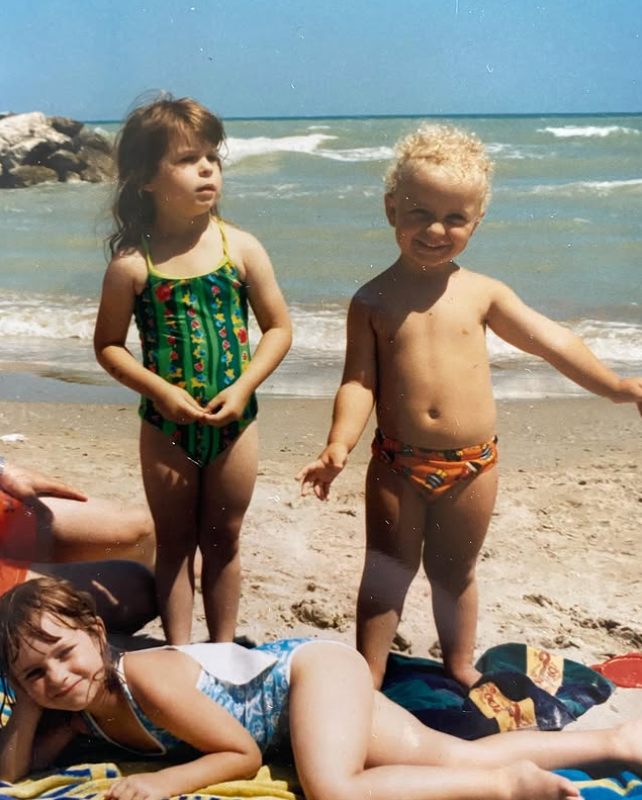
The cousins at work
As you might have guessed, these are stone beaches, which are common along Italy’s eastern coast. There are sandy beaches too, in Civitanova, they begin just on the other side of the pier, but over the years I have come to prefer the stones. The stabilimenti, classic beach clubs, stretch along the shoreline like a string of pearls, and ombrelloni (literally translates to “big umbrellas” which I, for some reason, find very funny) are practically mandatory. In the older establishments, you usually talk to some absolute beach legend, the most tanned person you have ever seen in your life, to get one. My grandma was the only one who always got a sdraio, the classic beach chair, while the other adults preferred lettino, the sunbed. I still find it iconic when I see someone in a sdraio.
If you are a local, you book your umbrella for the entire season, from early May until late September. My parents insisted that we should have prima fila, the first row of ombrelloni closest to the water. There are beach politics at play here that remain well beyond my understanding, but they managed to secure a corner spot at the establishment down the street.
Admittedly, there are two umbrellas in front of ours because we are at the corner and they decided to add a few “on the sides”, a very Italian solution. The law requires a five-metre strip along the shoreline to remain clear for passeggiata, but apparently that requirement becomes somewhat flexible if the umbrellas are technically on the side. I am not entirely convinced by the legal reasoning, but you have to admire the creativity.
Still, considering that Marebello, our childhood stabilimento and family headquarters, closed during COVID (a true travesty) I consider this quite an achievement. Especially since we are now competing with generational regulars, which we would have been ourselves had Marebello survived (did I mention that it is a travesty?).
In the evening, the venues along the lungomare transform from beach clubs into restaurants and bars, and later into full-fledged nightspots. Today, Civitanova is actually quite the party town.
For generations, we have remained loyal to the same places. Perhaps even more so now, as so many have disappeared through the various crises of the past decades. The ones that remain are cherished like heirlooms, and we usually order the same things every time. At L’Oasi we have calamari fritti and pentolaccia con primi, a local seafood pasta. It’s part of the family lore that my brother, as a toddler, ate half of my dad’s plate, and that was the last time he didn’t get his own pasta.
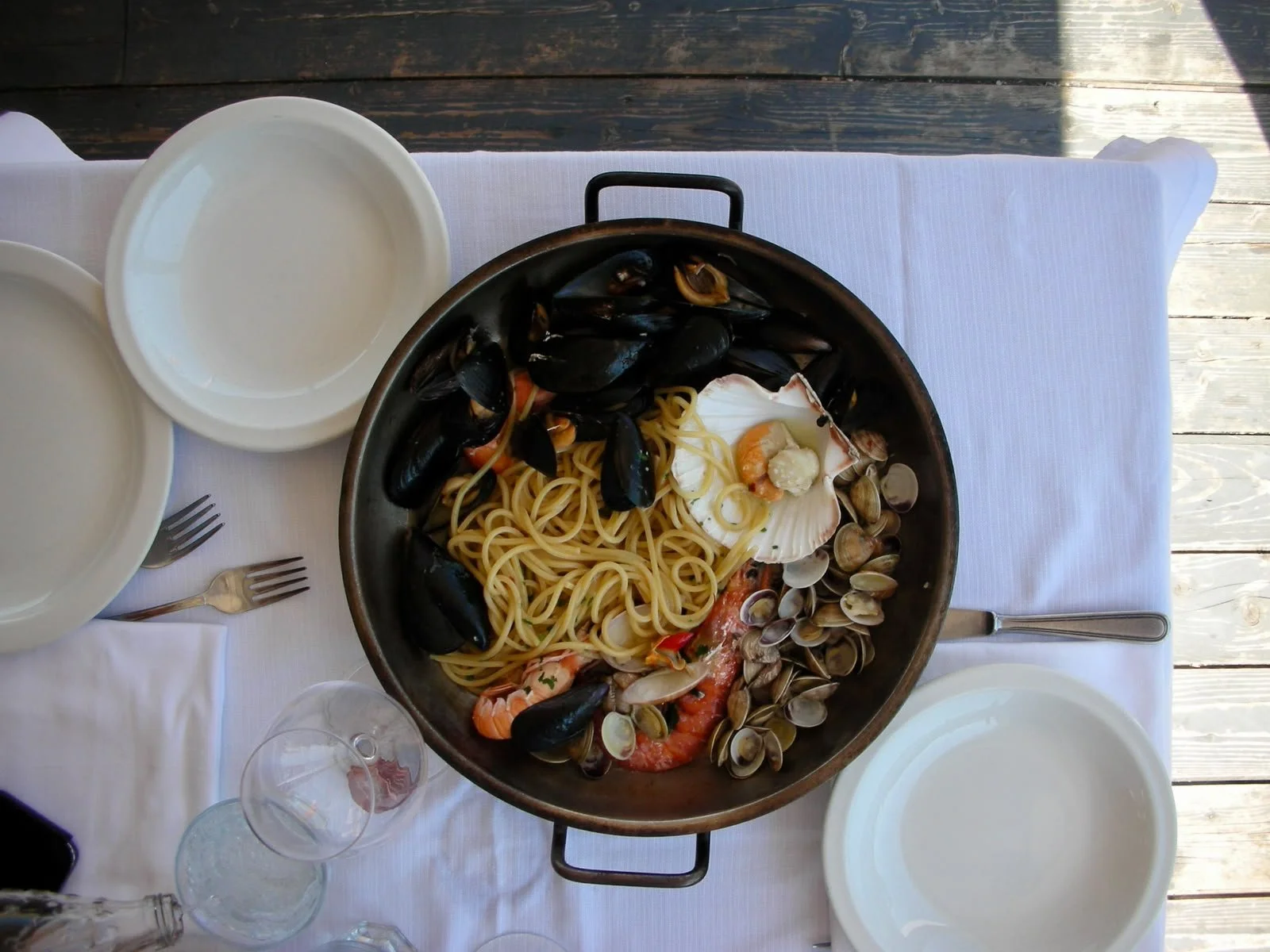
Pentolaccia con primi - the name comes from the word pentola (pot/pan) and roughly means “the big seafood pot”
As in most coastal towns, fish is the obvious choice here. But surprisingly, one of the best places nearby is Dasanta Vino e Bottega, known for its taglieri. We often run into friends who live out in la campagna, the hilly countryside inland, so apparently it is good enough to justify the drive.
Two years ago, when I turned thirty, my best friends joined me here to celebrete and this year my (much younger) little sister will come for her first solo trip with friends. They will no doubt raid the Saturday market in the piazza and drink far-too-strong gin and tonics. In Civitanova it’s half and half. According to my dad, this is because he personally taught the local bartenders how to make them as a teenager, back when gin and tonics weren’t yet a thing here. My dad is many things, but a modest storyteller is not one of them. Few Italians are.
These days I prefer the Sunday vintage market, which mostly sells things for the house, and occasionally some great leather jackets. Perhaps that confirms that I am now firmly in my thirties. When I was younger, though, the Saturday market was essential. Every year I would reinvent myself with my latest finds, returning home convinced I had an entirely new Italian style. Unfortunately, I never quite had the courage to maintain it for more than a few weeks once I was back.
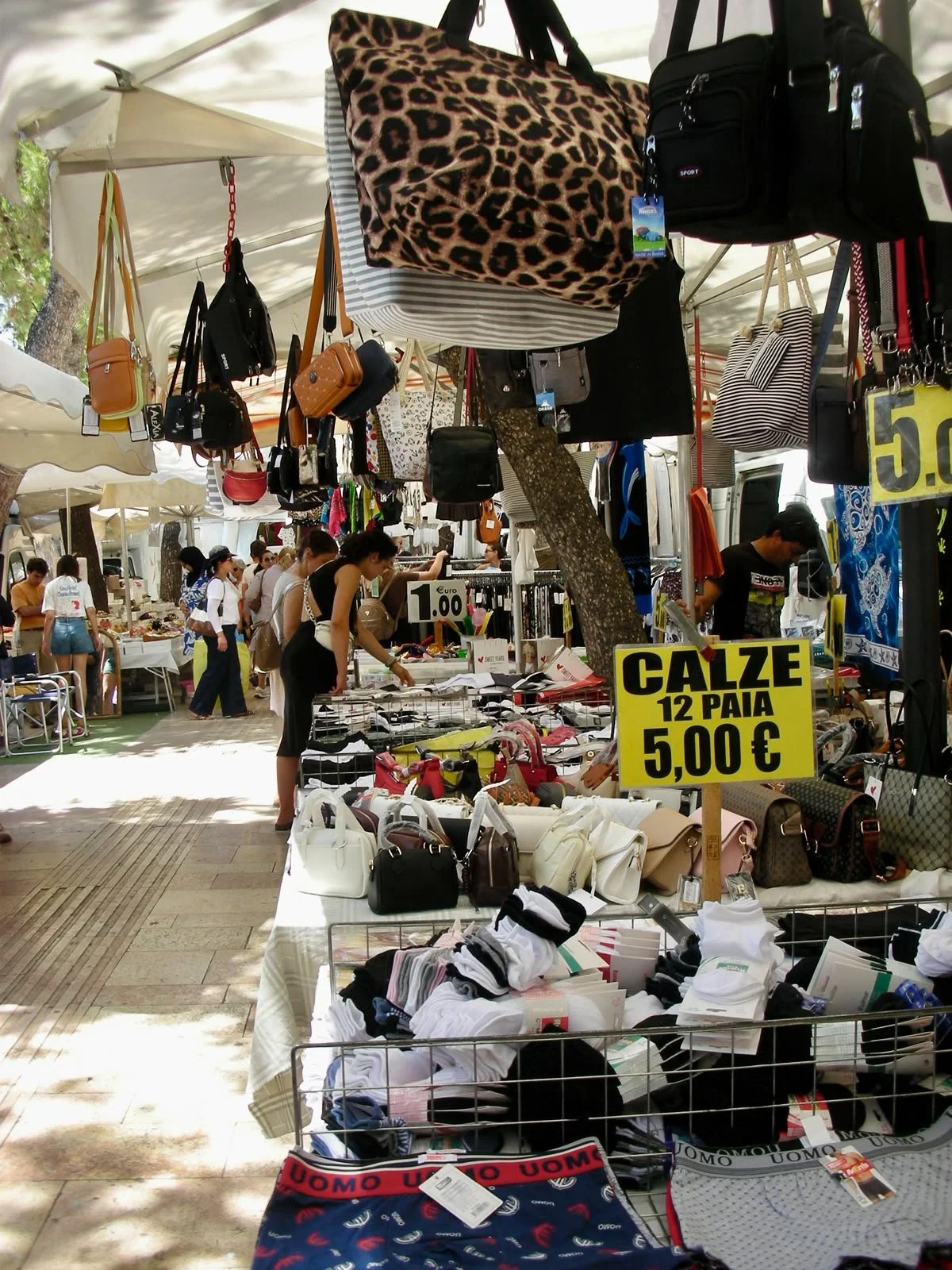
The Saturday market
In many ways, this place has become a temporal bridge for me, a sort of web onto which I can anchor different moments in time. In your twenties, the present is at the centre of attention. You are on a quest to get to know your adult self, and every emotion feels worthy of both experiencing and analysing. In your thirties, however, you begin to live more in the future. You are planning ahead. People are getting married, having children, reaching career milestones. If they are not, they are thinking about when they will, how they will, and what shape that future might take. In a recent conversation with a friend, we both agreed that we could live perfectly in the present if only we knew the future. Clearly, I still need to work on my dolce far niente skills. It is really the only true way to do an Italian summer.
When I think about the future, I often find myself thinking about the past as well. There is the present, a dot of some sort, and around it a tangled ball of time. Every thread stretches both backward and forward. When I pull on the future, old memories move with it.
Where am I going with this?
Nowhere, really. I’m just thinking out loud, or, in this case, in writing. About sitting at the same restaurant, ordering the same piatto, but with a toddler in the place that used to be my grandmother’s.
I wonder if that kid will eat half my pasta.
It’s peculiar how a place can make you feel like time is standing still and slipping through your fingers at the same time.
Un bacio,
Stella Scocco
—
To do in town
L’Oasi
Fish restaurant and beach club (stabilimento balneare) right on the water at Lungomare Piermanni 14. Run by Angelo Berettoni, offering fresh fish, pentolaccia, and homemade pasta with a sea view. Open year-round, closed Tuesdays. Phone: 0733 816396.
Dasanta (Vino e Bottega)
wine bar / bottega at Viale Vittorio Veneto, 14, Civitanova Marche. Phone: 351 306 2319. A wine-and-small-plates spot, good for an aperitivo or light dinner away from the beachfront crowd. Instagram
Mercato del sabato (Saturday market at Piazza XX Settembre)
Held every Saturday, year-round, in Piazza XX Settembre, from 8:00 to 13:00, with food, clothing, produce, fruit and vegetables, and local products. Locally called “Citanò” in dialect — it’s a weekly ritual drawing locals, tourists, and people from across the Marche provinces, who start the morning with breakfast in the area’s cafés and often end with an aperitivo nearby. The market spreads along Piazza XX Settembre and Corso Dalmazia into the old fishing quarter known as “Shangai.” Best known for shoe/fashion bargains — arrive early for best sizes.
A car ride away
Monte Conero
The green promontory towering over the bay — home to beaches like Spiaggia dei Sassi Neri, Spiaggia del Frate, and Mezzavalle, most reachable via hiking trails or narrow coastal roads. Good for hiking and panoramic drives connecting Ancona down to Sirolo and Numana.
Portonovo
Bay on the Riviera del Conero, near Ancona. Nicknamed the “baia verde,” flanked by rocky cliffs up to 400 meters, with white pebble and calcareous gravel beaches, all flying the Blue Flag. Famous for wild moscioli (wild mussels) that grow on the rocks. Also home to the Romanesque Chiesetta di Santa Maria di Portonovo (11th century) and the Fortino Napoleonico. Getting there: exit “Ancona Sud” on the A14, follow signs for Camerano/Poggio through the Parco del Conero. Parking is limited in high season, use the upper car park and shuttle if needed!
Civitanova Alta
The old hilltop town, about 6 km inland from the coast. A medieval borgo still enclosed by ancient walls with four gates, one of them, Porta Marina, famously has a cypress tree growing right out of its brickwork. The main square, Piazza della Libertà, is ringed by the Palazzo Ducale and the churches of San Paolo and San Francesco. Also home to the Teatro Annibal Caro, the Pinacoteca Comunale Moretti (with works by Carrà, Morandi, De Chirico, Guttuso, and Ligabue), and a Liberty-style 1900 tram station.
