
Nearly two millennia ago, before paved streets and a buzzing nightlife, the landscape outside the Aurelian walls was mostly fields. The views were interrupted only by the Basilica of San Lorenzo fuori le mura, built on the grave of the martyr Saint Lawrence (whose Italian name was, you guessed it, San Lorenzo).
Lawrence was born in 225 and came to Rome as a small child, alongside the man who would one day become Pope Sixtus II. Around three decades later, Lawrence became a deacon of Rome, responsible for distributing alms to the poor. Times were different then, and being a deacon was not quite the position it is today. Christians were often persecuted as they refused to worship the Roman gods and the emperor himself, and only a year after the appointment of Saint Lawrence, Emperor Valerian ordered the immediate execution of all deacons.
According to legend, after giving away all the church's wealth to the needy, Lawrence gathered the poor and the suffering, and when the soldiers arrived, he declared, “Here are the treasures of the church. You see, the church is truly rich, far richer than your emperor!” A tale poetically fitting for San Lorenzo’s modern history.
Between the days of Roman emperors and San Lorenzo today stretches a long, uneven evolution - a history lesson I will spare you. Instead, we leap forward around 1,500 years, to when the neighbourhood began to assume its recognisable working-class character following the unification of Italy in 1871. Built around the goods yard (it remains in use today) and the Rome-Tivoli tramway, San Lorenzo became a neighbourhood of artisan workshops, political activism, trade unions and anti-war protests.
When the fascists came into power, raids on the district became frequent. But they were met with fierce resistance, including women throwing pans of boiling water from windows at the marchers. As you can imagine, this was not appreciated by the people in power, and in 1922, a battalion of five hundred fascists, backed by military forces, carried out a retaliatory attack, targeting union headquarters, taverns, and known anti-fascist homes, resulting in the deaths of thirteen Sanlorenzini.
In some accounts of history, the resistance is described as an effect of these attacks, but rather, it was the opposite way around.
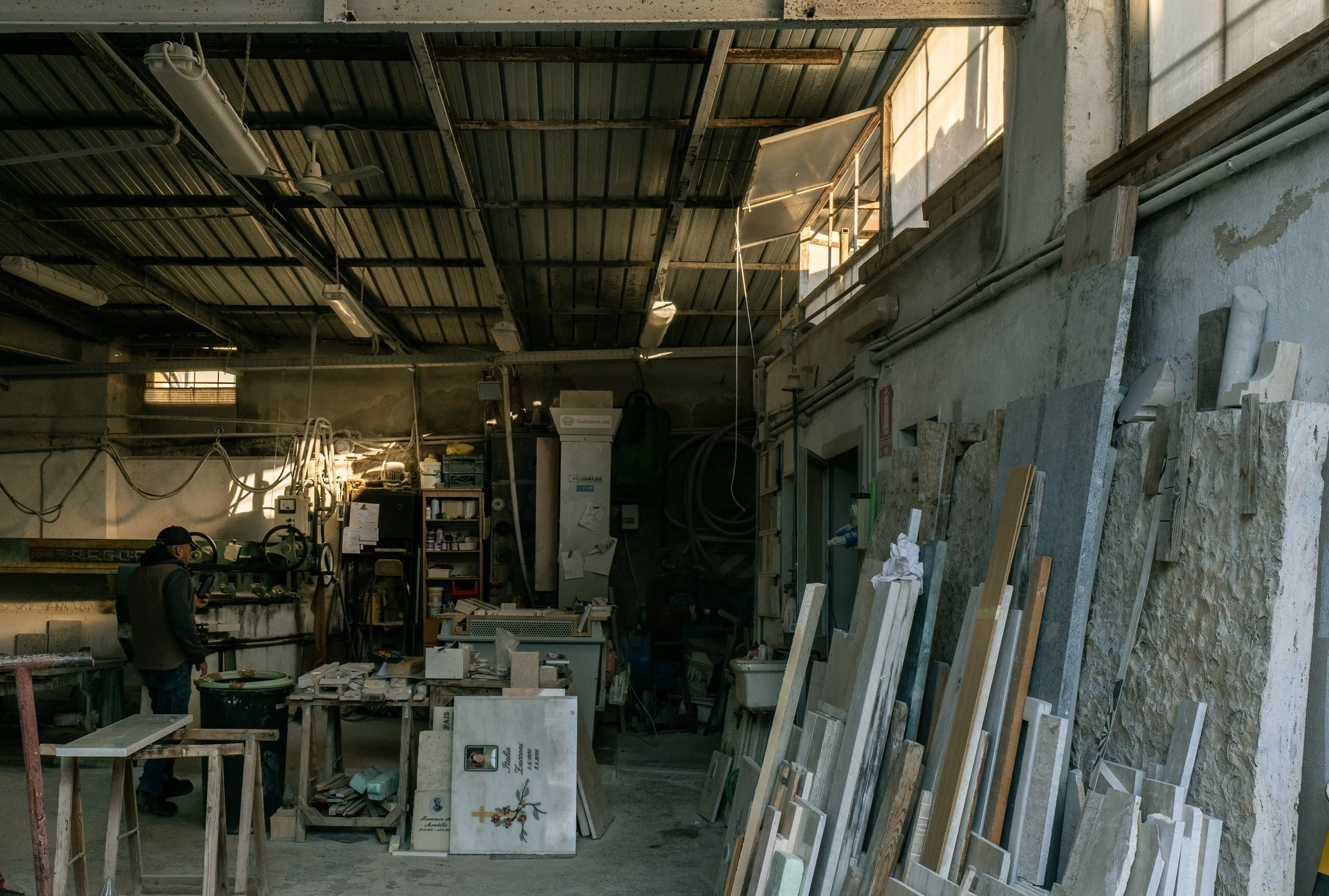
Photo by Isabella Zirrilli, Fulvio, Rome, 2026.
Only two decades later, the community of San Lorenzo suffered yet another tragedy when Allied forces in 1943 dropped 4,000 bombs over the area in a single day. Whilst the exact number of deaths is disputed, at least 1,674 people were killed, their names are today engraved on metal plates in the memorial park in the heart of the neighbourhood. That an anti-war, anti-fascist community suffered the worst is a wound that would never fully heal.
It was later understood that the Allies had taken careful measures to protect Rome’s ancient monuments; civilians, on the other hand, had not been afforded the same consideration. The fascist regime fell only six days later.
After the war, San Lorenzo became known as Rome’s “red district.” It became a centre for the extra-parliamentary left and student radicals. In the decades to come, the legacy persisted and evolved: when Cinema Palazzo – a neighbourhood cinema built in 1931 – was evicted and in danger of becoming a casino, residents, along with several artists, walked in and stayed, turning a protest into an occupation. This, and many other similar community efforts, are a sign of a new form of resistance. The Sanlorenzini are no longer fighting emperors or fascists, but a more diffuse force - one that nonetheless threatens the community’s existence. They are fighting gentrification and, in a sense, market logic itself.
But what is gentrification, and why resist it? It often begins with artists or young professionals seeking affordable housing, followed by wealthier groups – drawn in precisely because the area has become a “cool,” artsy district. Developers, sensing opportunity, soon follow, and as we know, money tends to follow money. Ultimately, it often ends up with the replacement or displacement of the original inhabitants. The process, often slow, can be hard to notice, but before you know it, your local cafe has been replaced by a Starbucks.
Gladly, this does not seem to be the case for this historical Roman neighbourhood. Organised groups are fighting rising rents, housing injustice and the spread of short-term rentals.
Social centres are reclaiming and maintaining spaces for collective, non-commercial use. And, if you spend a day here, you will see posters, assemblies, and public statements targeting the same issues. Wherever you go in this historical area, you will see resilience and resistance. The question is not whether San Lorenzo will change – it already has – but whether its long-standing capacity to resist will once again shape what that change looks like. If the legend of Saint Lawrence is about redefining what counts as wealth, the inhabitants of San Lorenzo continue to honour his sentiment. Time and again, the Sanlorenzini have asserted that a neighbourhood cannot be reduced to an asset class but is defined by the people living there.
Interestingly enough, Saint Lawrence’s declaration remains equally true today – the people are the true wealth of this neighbourhood. Looking back, resistance, whether to Roman emperors, fascism or capitalism, seems to be in the DNA of San Lorenzo. Given this, I think the capitalist gods will have a hell of a fight turning these local cafes into Starbucks.
