
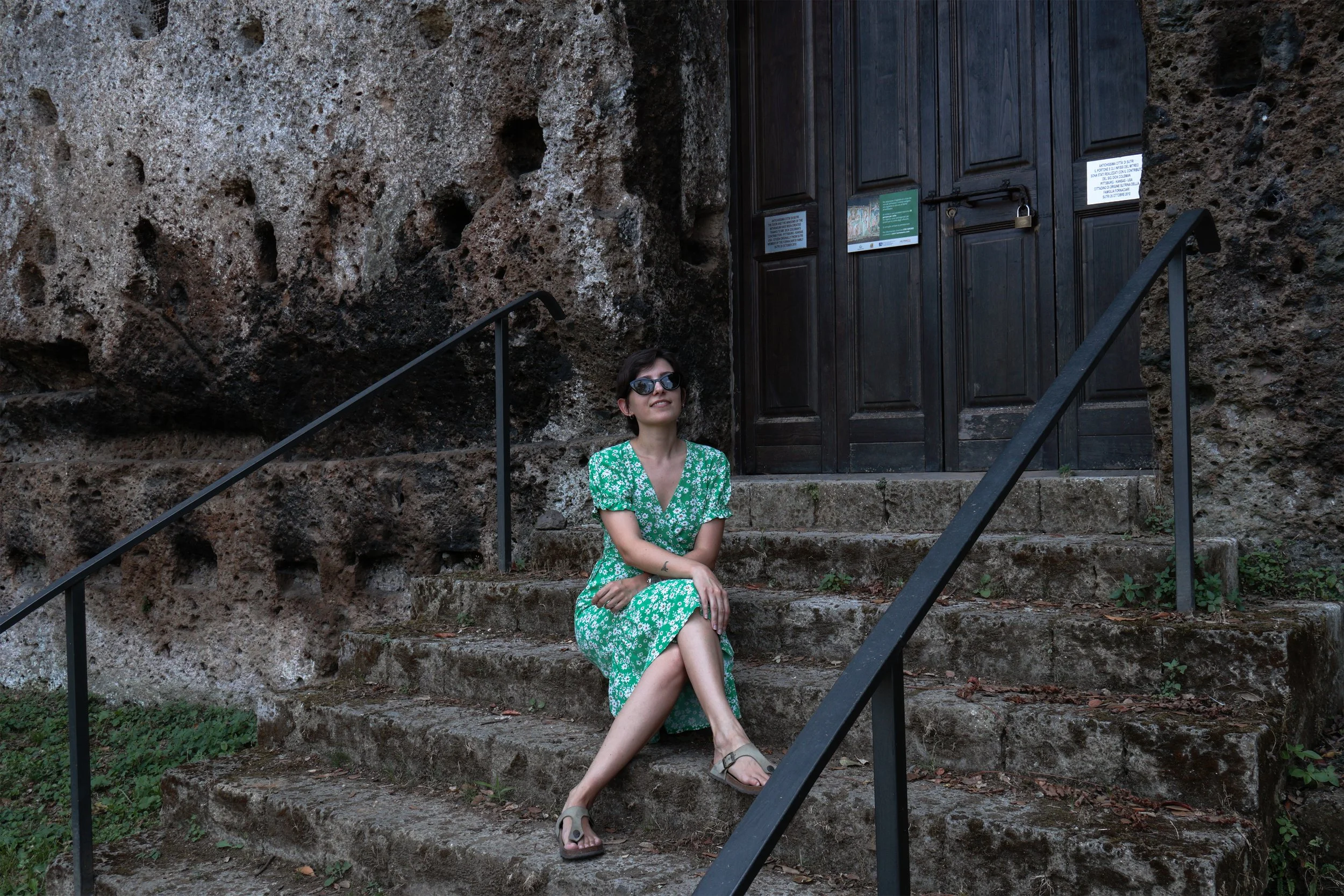
Tanita Dzoba is a Rome-based architect, artist and photographer. Find her on Instagram here.
Sutri, July.
I’m sitting here in my room, the one with an “apple green” wall, looking outside the window in front of my desk, and seeing more green, my favourite colour. It surrounds the house: the trees, the bushes, the carefully watered grass in front of the patio. My dad is so proud of it that he could mow it and take care of it even under the hot midday summer sun; it’s the most important part of the garden for him.
The singing of the cicadas is loud, but we’re so used to it that we don’t even notice it anymore. I can hear the sound of the pool filtering the water, and the little robot vacuum that we named Johnny doing his job cleaning the bottom of the pool. I’m waiting for the clock to tell me it’s late afternoon, the heat is bearable and I can go outside for a little swim and to sunbathe.
This place is my little corner of paradise, the house my dad built for us (I helped just a little bit) to escape the chaos of Rome. We moved here to Sutri nine years ago, to this ancient, lovely town about 50 km from Rome. I spent only a couple of years here as a resident, moving back to Rome to live on my own and not having to face almost two hours of commute to get to university. Since then, I have called it “my parents’ house” when I talk to other people, but it’s actually the only place where I truly feel at home.
My absolute favourite ritual here is the morning tea in the garden. I get out of bed, go to the bathroom, which is the most light-filled room of the house at that time of the day, and wash my face to actually feel awake (I’m not a morning person). Then I go downstairs to the kitchen and start brewing Earl Grey tea in my handmade ceramic tea set, grab some cookies and head to the garden with a tray in my hand and a book under my arm that I most likely will read for only about 10 minutes, because I will get lost in my thoughts for the rest of the time. For me it’s the slow life at its best.
I must say, winters here can get pretty depressing, as in a lot of small towns around Italy, but now it’s summer and it’s filled with life, so I’m enjoying it while it lasts. It can actually feel pretty busy this time of the year, so I’m glad our house is just outside the town and next to the woods. Nevertheless, the cultural life here has a lot to offer, and I would like to tell you more about it.
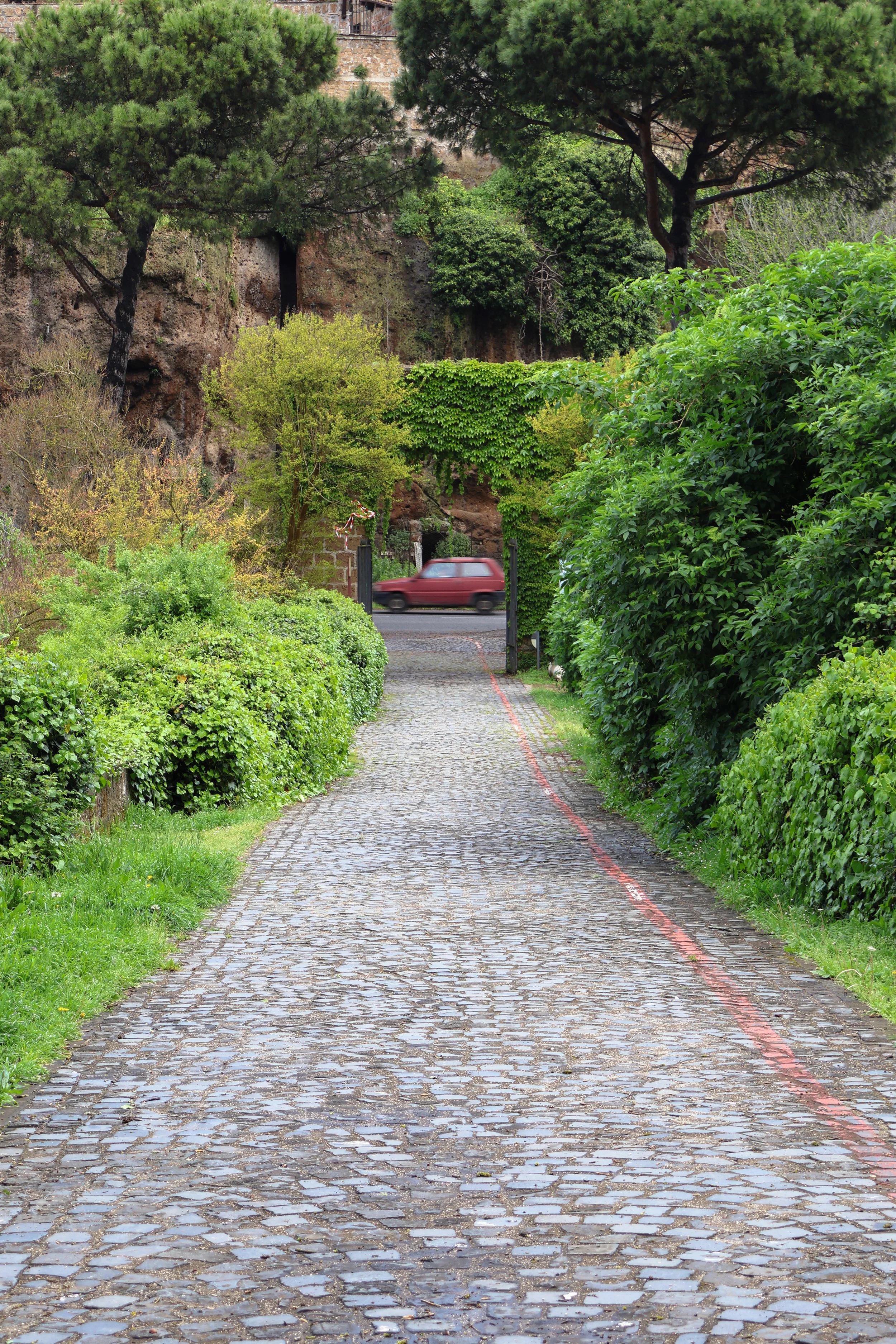
Parco Naturale Regionale
First, a brief historical and geographical context. We are a little bit more than 50 km north of Rome, in an area called Tuscia that encompasses the north of Lazio and the territory at the border with Tuscany and Umbria. It’s a very characteristic area that was historically inhabited by the Etruschi, a people known in Italy for building entire cities for the dead – called Necropoli - that mirrored the cities of the living. Today, you can go for a hike in the woods or for an easy stroll just outside the city centre to discover the tombs carved in tufo rock more than 2000 years ago. I confess that the first time I saw an Etruscan necropoli it gave me an eerie feeling, but now that I’m used to it… I still feel the same.
If you’re passionate about Italian cinema and want to get a taste of Tuscia, I highly recommend watching movies by Alice Rohrwacher, a very talented film director who often collaborates with her sister, the actress Alba Rohrwacher. The two of them were born in Tuscany but raised in a small town just on the borders of Tuscia, and in my opinion, they are the best at conveying the spirit of this land.
Among all the important historical landmarks we have here, you really cannot miss the Anfiteatro, the ancient Roman amphitheatre carved in tufo that every summer hosts a music and theatre festival. You can enter the Parco Regionale Naturale from Via Cassia, go up to Villa Savorelli, walk along the Bosco Sacro until you reach the belvedere, and there it is, the most beautiful view of the Anfiteatro – from above. Once your eyes are full of it, you can go back to the entrance of the villa, go down the ramp and then continue the walk all around the hill – and then you will discover some Etruscan tombs.
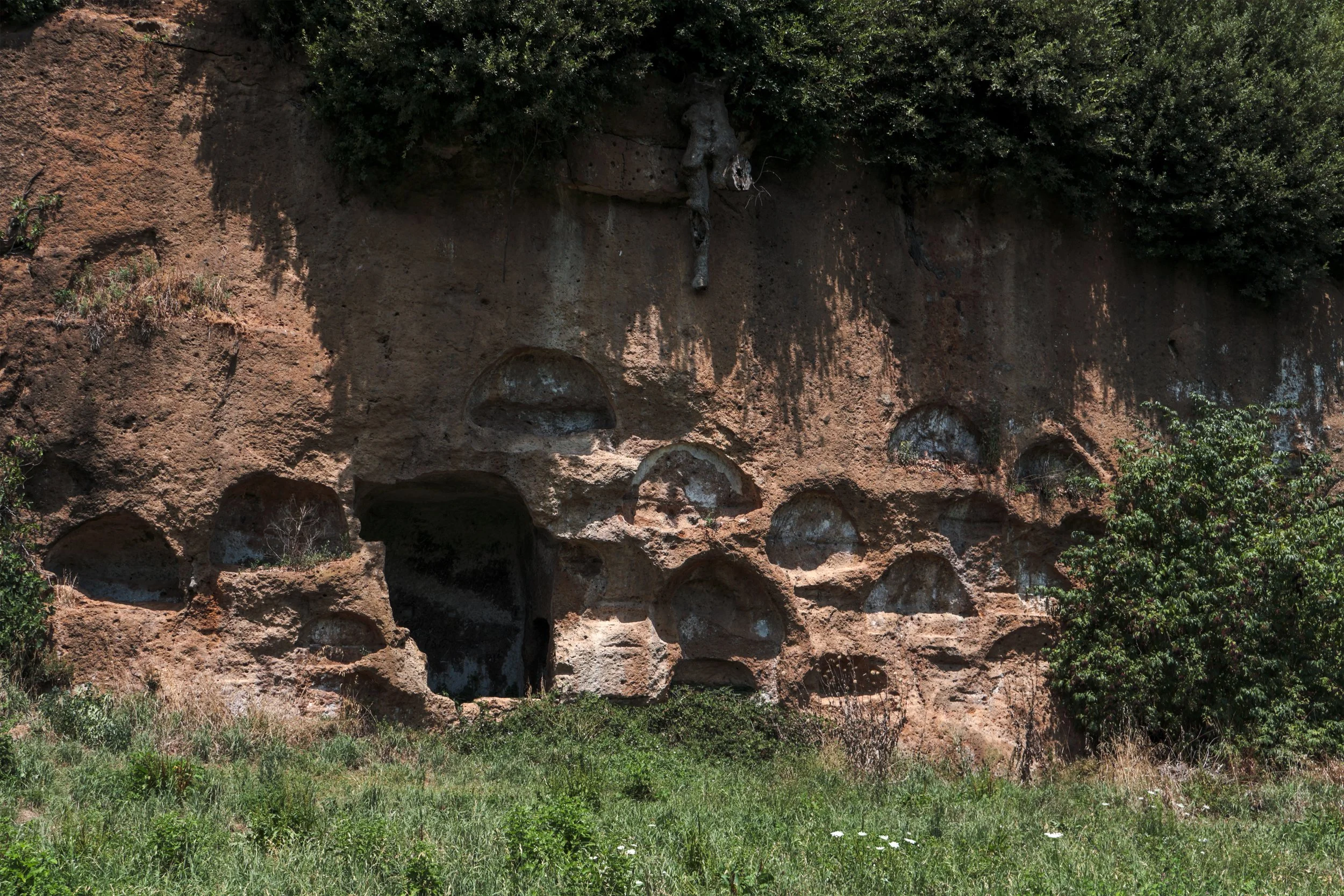
The Etruscan tombs
This year, Estate Sutrina is hosting events until the end of August, with concerts, comedy and experimental theatre shows all around the most charming corners of the town. My mom’s favourite are the concerts by Jazz for SLA – a non-profit organisation that tours all of Tuscia with amazing musicians, raising awareness and funds for research into ALS. But there’s nothing more Italian than a good old sagra - a local festival celebrating an annual event such as the consecration of a church, the patron saint of a town, or more often a harvest. Here in Sutri, the event of the year is the Sagra del fagiolo, held at the end of August, where you can taste all the best recipes based on beans. I know, it’s not your usual summer tomato salad, but still, it’s worth trying.
See you at the sagra,
Tanita Dzoba
Tanitas Sutri tips:
Drinks and food
JINTO
A Bar, Bistrot and Restaurant that offers the best Gin selection. If you’re not a fan of Gin-tonic, you’ll become one after trying their cocktails. The best location for an aperitivo in Sutri. Open from Tuesday to Sunday, closed on Mondays.
Adress: Via Giovanni Andrea dell’Anguillara 4
CANTINA DEL DRAGO
My family’s favourite choice when it comes to a special lunch or dinner. The place to go when you feel like sitting in a hidden garden and trying out some unexpected food combinations. Open every day, closed on Mondays.
Address: Piazza San Francesco 17
ANTICA NORCINERIA BOMARSI
You walk past the Piazza del Comune, you see a little shop selling local cheese and meat products. It looks delicious, so you go in. You can’t decide what to buy, so they offer you a little taste of their best affettati and caciotta. “Maybe you want something to drink too?” And then you notice they also have craft beer and a little wine selection. Now you cannot resist, so you stay there for an hour or two, drinking beer and ordering one tagliere after another filled with their best products. Open every day except Mondays; on Sundays, they close at 14:30.
Adress: Via Roma 6
Museums and Churches
MUSEO DI PALAZZO DOEBBING
Previously the Bishop’s palace, today it’s one of the most interesting museums of Tuscia. It has a small permanent collection of Etruscan artefacts and there are always some temporary exhibitions of contemporary artists. Open on weekends, including Fridays, 10-13/15-18h.
Adress: Piazza del Duomo
DUOMO DI SANTA MARIA ASSUNTA
The Cathedral of Sutri, with a peculiar floor mosaic called pavimento cosmatesco. But once you’re here, you cannot miss the cripta right under the altar – prepare a 1€ coin if you don’t want to get lost in the darkness.
Adress: Piazza del Duomo
CHIESA DELLA MADONNA DEL PARTO – MITREO DI SUTRI
A Mitreo, or Mithraeum, is a temple erected in ancient Roman times by the worshippers of god Mithras. These temples are usually carved in stone, adapted natural caves or built underground. The one in Sutri is an artificial cave and it’s easy to notice – you just have to go to the park next to Anfiteatro and look for a wooden door placed in the middle of the rocky wall.
When Christianity became the main religion of the Roman Empire, many of the temples became churches. The Mithraeum of Sutri became the place of worship of the Holy Mother of Childbirth. Closed on Mondays, you can visit the church only with a guide – ask at the ticket office next to Anfiteatro. Last visit at 14.30 on weekdays and 16.20 on weekends.
Adress: Piazza Sacello 39