
In the spring of 2025, I was sitting with my colleagues at a coffee shop, discussing what they called the “destruction” of the Minerva statue at Sapienza University. I’m using the quotation marks because it was hardly destroyed – rather, someone threw paint at it, which was removed a few days later.
Minerva is somewhat of a university legend in Rome. Her statue stands in the main piazza of the campus, impossible to ignore and yet, famously, never looked at. The legend has it that if a student looks directly into her eyes, they will fail their exams for the semester, so they avoid her gaze as they would that of her mythological counterpart, Medusa.
Minerva, the Roman equivalent of the Greek goddess Athena, has symbolised wisdom and intelligence since Hellenic tradition. She was born directly from the head of her father, Jupiter. As a metaphorical consequence, Minerva embodies ingenuity, rationality, and knowledge, representing craftsmanship, warfare, mathematics, and science. It is, in other words, understandable why she would stand at the centre of a university campus, and why the respect for her has translated into a superstitious ritual.
In the weeks prior to this coffee shop encounter, discussing the “destruction” of the mythical statute, Ilaria Sula, a 22-year-old student at Sapienza, was murdered. Her ex-boyfriend, also a student, confessed to the crime. The university principal, Antonella Polimeni, condemned the killing as an “atrocious and brutal femicide” and dedicated a new study room to Sula. The murder occurred within 48-hours of the murder of another young woman, Sara Campanella, in Sicily.
With the high-profile murder of Giulia Cecchettin (November 2023) still imprinted in Italy’s cultural memory, the events prompted widespread outrage and renewed calls for a “cultural rebellion” against gender-based violence. At Sapienza, a major student protest erupted, initially gaining broad support from fellow students, staff, and the public. Until they “destroyed” the newly renovated Minerva statue.
This action struck a chord; the inhabitants of the eternal city – often called a museum in the open – take great pride in its cultural heritage, and respect runs deep. In a now deleted post on social media, Polimeni published a statement condemning the vandalism, with a message along the lines of “We don’t want women to die either, but you took it too far”. Like a parent, she lectured the students on good behaviour, boundaries and the difference between means and ends. She was on their side, but they needed to learn respect.
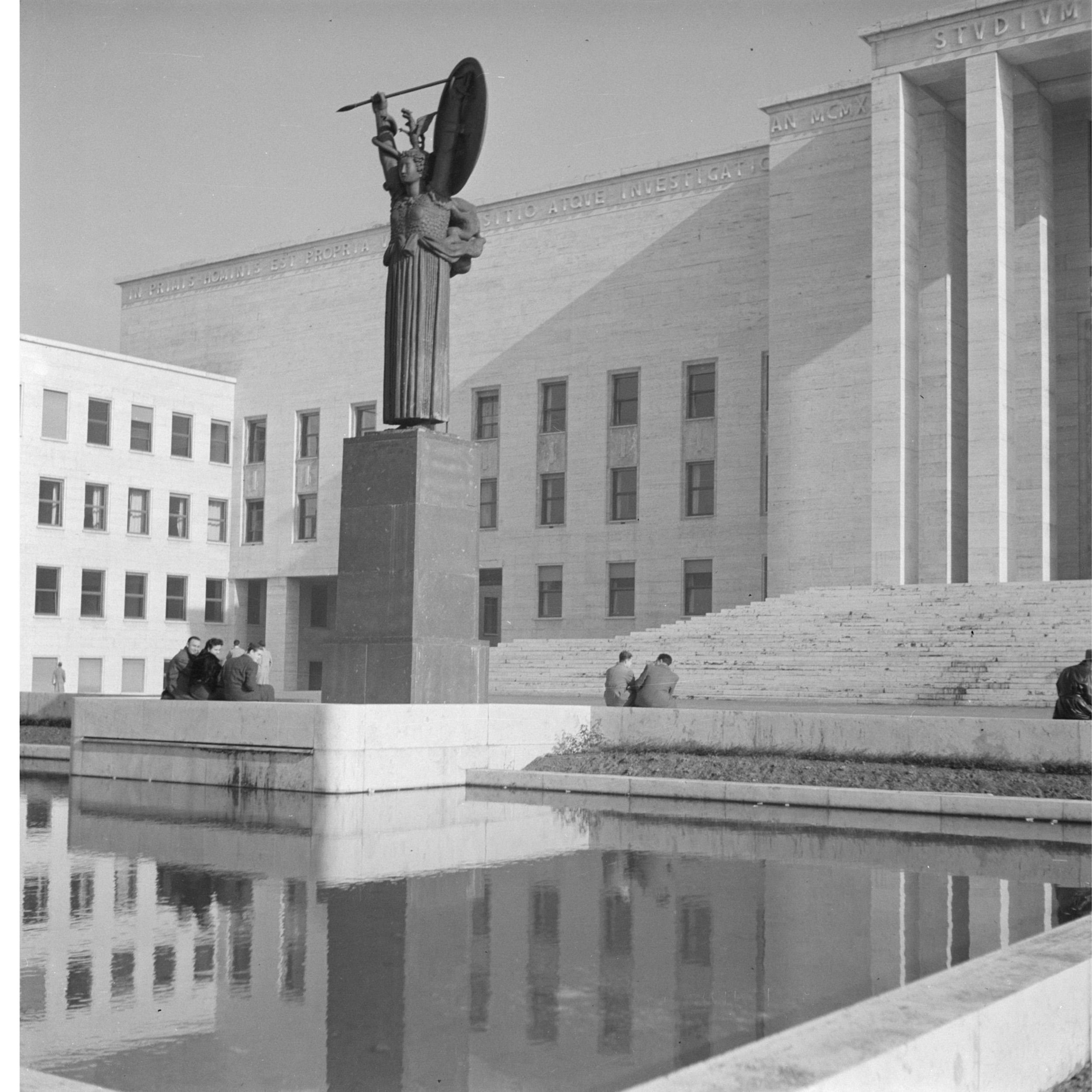
The Minerva Statue at Sapienza University, Rome
Zooming out, ever since the tragic murder of Giulia Cecchettin, the murder of women has been on the political agenda. In November 2025, the Italian parliament unanimously passed a law recognising femicide as a distinct crime in its criminal code, punishing gender-motivated killing of women with life imprisonment. The law defines it as the intentional, gender-motivated killing of a woman or girl. As legal analysis tends to be tedious, let’s simplify it a bit and say that by creating a distinct offence, the legislature is effectively saying: this is not homicide, it is a structurally different form of violence.
So, what is the difference? Observers have long described violence against women as a systemic issue, deep-rooted in patriarchal attitudes, rather than isolated incidents. The adoption of the legal term femicide says exactly this: women are being killed for being women.
But why are women being killed for being women?
The Council of Europe has attempted to answer that very question, and their findings can be summarised as follows: patriarchal and sexist views uphold the dominance and superiority of men. This encompasses gender stereotypes and prejudices, normative expectations of femininity and masculinity, the socialisation of gender roles, and a perception of the family as a private sphere under male authority.
I don’t believe it is any secret or controversial to say that Italian society still grapples with stereotypical gender roles and ingrained sexism. On paper, the country is modernising, and national strategies promise progress. In reality, modern frameworks meet deeply rooted traditions (as is true in many areas of the law), and Italy still trails many of its European peers, ranking 35th out of 40 in Europe in the 2025 Global Gender Gap report.
The numbers do paint quite a dire picture. Only 52.4% of working-age women in Italy are employed, compared to 70.3% of men, the widest gender gap in the EU. Care work remains heavily gendered: 41% of women spend more than five hours a day on domestic childcare, compared to just 16% of men, and about one in five women leave their jobs within a year of having their first child.
Attitudes reflect and reinforce these disparities, and around a third of Italians believe that success matters more for men and that men should be the primary breadwinners.
In the non-economic domain, more than half of Italian women report experiencing harassment. Court rulings, such as overturning a rape conviction based on the victim’s appearance (too ugly to be raped, no, I’m not joking, I really wish I was) or dismissing groping because it lasted only seconds (by a janitor at a school on a young girl), highlight how gender attitudes can penetrate legal reasoning.
Structural barriers also persist in reproductive rights and family law. Around 63% of gynaecologists refuse to perform abortions, and, under Italian law, women must wait 300 days before remarrying – a rule tied to paternity concerns that does not apply to men.
Nevertheless, gender inequality is still scarcely covered in the media: just 2–3% of news reports focus on the issue, and women are often depicted as objects rather than active agents.
What does this tell us?
Gender equality in Italy isn’t just a policy issue; it’s a matter of cultural inertia. Whilst the enactment of laws, such as femicide – one of the most progressive laws against gender-based violence in Europe – is an official recognition of the symptoms of a patriarchal culture, it is just that: a recognition of a symptom.
Scientific research indicates that harsher sentences are not an effective, evidence-based method for reducing crime or recidivism. While the intuitive belief that harsher punishments deter crime is common, decades of research have failed to find evidence that tougher sentencing leads to lower crime rates. The idea of deterrence assumes potential offenders rationally calculate the risks. However, most crimes are committed without regard for future consequences.
It is important that my reasoning not be interpreted as an attempt to absolve anyone of personal accountability. However, while individuals have an obligation to follow the law, society has a responsibility to address conditions that can exacerbate crime. The root causes of crime are well-documented and researched. Crime is primarily the outcome of multiple adverse social, economic, cultural and family conditions. This fact matters because it reframes the issue. Not as isolated acts of violence by bad men, but as the outcome of a cultural system.
Cultural inertia rarely stems from bad intent but from a belief in “perceived truths” deeply rooted in culture and passed down through generations, such as the idea that women are better listeners, that men are better drivers, that it’s more important for men to succeed, and that women are simply better at cleaning. Or knowing to fear the gaze of a statue.
Minerva, the goddess of wisdom, of knowledge, of what is considered rational, but also perhaps, of what we accept without questioning, tradition and paradigm. And maybe that is exactly the point. The students, by “destroying” Minerva, looked her in the eyes. It’s a cultural act. By doing so, they challenged her and what she stands for, fearless of ancient superstition and disrespectful of traditions. If the problem is cultural, the solution cannot be just legal, nor can it be a study room. It requires something deeper, something uncomfortable. This might even mean reevaluating our cultural roots or risking the loss of ancient landmarks, both physical and mental.
