When a minister's advice on “good wives” and a burqa ban collide - Inside Italy’s latest clothing panic.
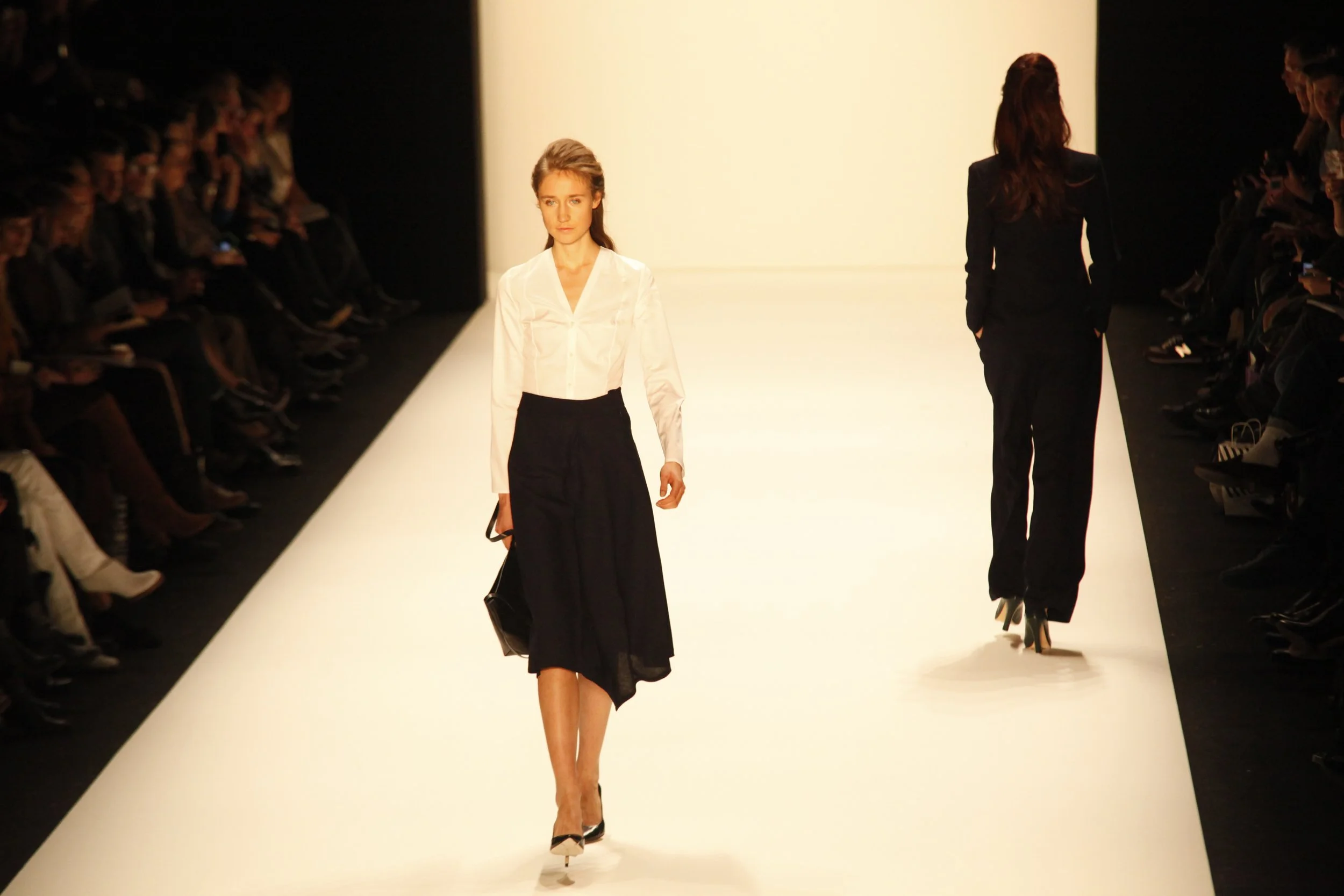
Acceptable skirt length on the runway? From Berlin Fashion Week 2013, by Patrick Raczek.
Italy’s foreign minister Antonio Tajani has become a meme, least to say. On Tuesday last week, a clip from a party rally just outside of Rome circulated online, in which he tells the story of the advice he gave his son on how to find a good woman to marry.
– Sure, it’s nice to marry a glamorous girl, but she might have gone through a string of boyfriends and be prone to cheating, Tajani said.
And then made it worse by adding:
– I’d rather my son marry someone less flashy, more reliable, a good mother, someone who wears her skirts a little longer than the rest.
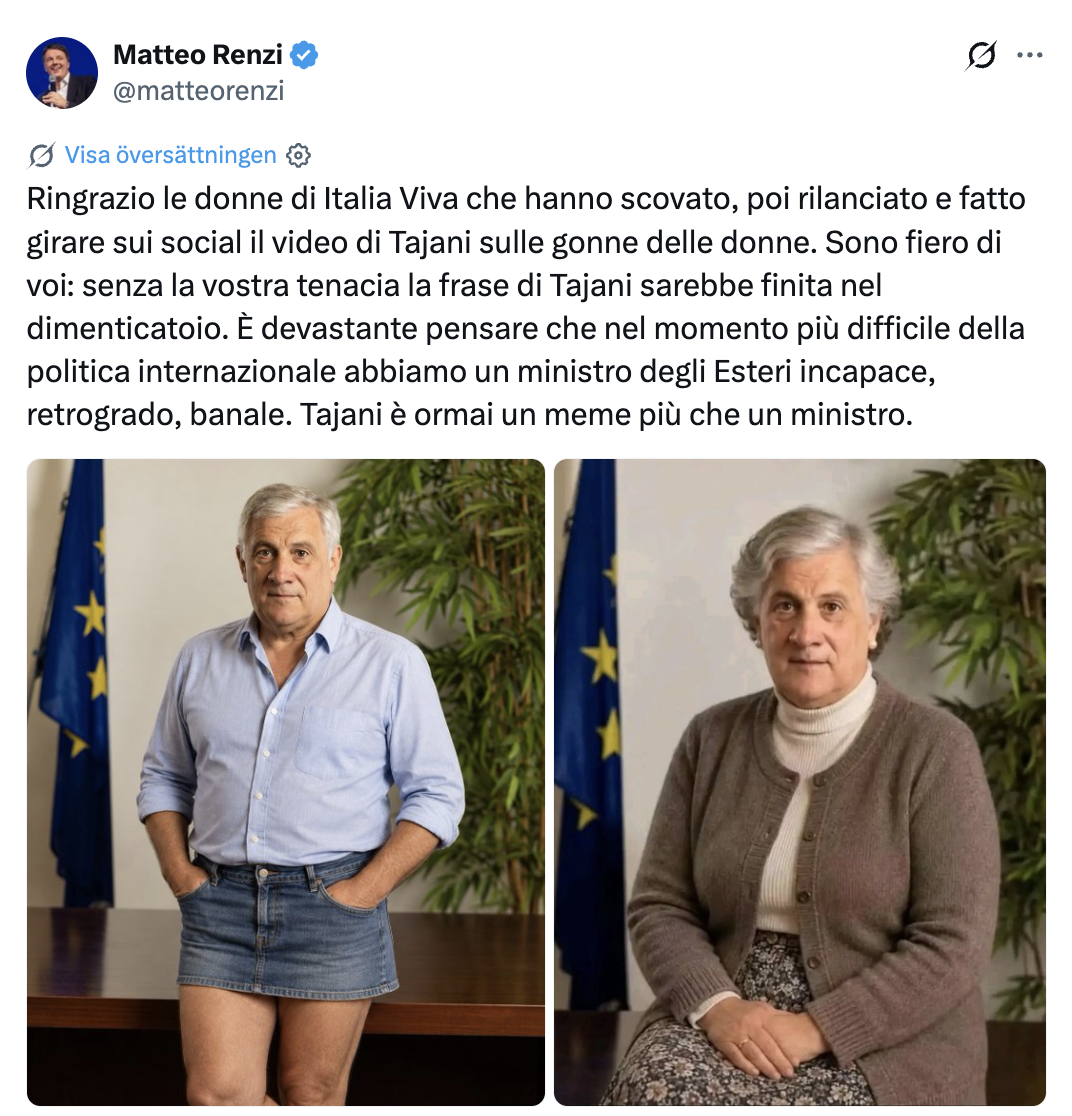
Ever since, the Italian memefactory has been on fire with AI-generated images of Antonio Tajani dressed in a miniskirt, in a floor-length skirt, as a fashion designer viewing an ankle-length collection on the runway and as a character from The Handmaid’s Tale.
Matteo Renzi, leader of the center-left party Italia Viva and former PM of Italy (2014–2016), wrote on X that “It is devastating to think that, at the most difficult moment for international politics, we have a Foreign Minister who is incompetent, backward, and banal. Tajani has become more of a meme than a minister.”
And later added on a Rai 3 talk show that judging whether a woman is reliable by the length of her skirt belongs in the 17th century.
Fiorella Zabatta, spokesperson for the opposition greens and left alliance, wrote that “Tajani isn’t decades behind the times, he’s thousands of years behind” and added that the government should “count the women who have been killed before measuring the skirt lengths of those who are alive”.
Several female members of the Senate showed up wearing miniskirts to the office after the clip went viral, proving that you can in fact remain respectable, no matter the length of your skirt.
At the same time Tajani was having the worst week, the Italian government approved a decree banning niqabs and burqas in schools, calling it a measure for safety and integration.
It seems like a very confusing week for Italian women, who have been told two opposite sides of the spectrum within a matter of a few days. Cover up, but not too much. And definitely not like the Muslims, because that’s also considered wrong.
It’s basically playing Goldilocks with moral panic. A woman cannot be not too bare, but also not too covered. She needs just the right number of centimeters.
This is however not something new. Rewinding the tape about ninety years is enough to find another Italian sartorial reference.
In 1935, Mussolini’s fascist government established a National Fashion Authority, called “Ente Nazionale della Moda”, a state institution to control the fashion industry while simultaneously instilling a fascist lifestyle through dress codes. The regime banned French and other foreign influences, urging women to seek inspiration in Italy’s “domestic roots” rather than in Paris, and to dress in home-grown materials like hemp or lanital, a wool spun from milk casein and other cotton substitutes, because a fascist woman was supposed to consume Italy, not import it.
Women’s clothing also became a sort of vehicle for state-sponsored ideals of motherhood and rural tradition. Campaigns like Massaie Rurali (rural housewives) promoted modest, peasant-style dresses over modern, Western trends.
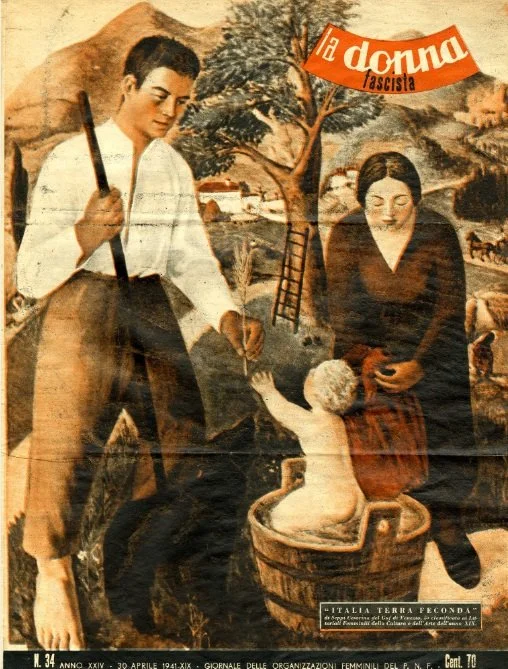
La donna fascista, 30 aprile 1941. Courtesy of Biblioteca Delle Donne.
In line with this, the regime also tried to persuade women to gain weight and promoted a rounder, more robust feminine silhouette suited for childbirth and rural labor.
It was a deliberate contrast to the slim, urban “flapper” look that dominated abroad, with short bobs, knee-length skirts and excessive makeup. A slender and androgynous woman was seen as a threat to the birth rate, and the birth rate was a matter of state. Even trousers on women were considered something close to a provocation.
During this period, the Vatican ran its own war aimed at women’s sportswear. Between 1928 and 1933, the Church’s newspaper L’Osservatore Romano waged a campaign against Italian female athletes’ shorts and sleeveless tops, describing them as a threat to modesty. During this time, the Italian athletics federation issued a directive that required female athletes to wear long trousers outside the competition arena itself.
Almost a hundred years have passed since then, but apparently, very little has changed. A woman’s body is still seen as public property, to be owned and regulated by the state or by a man. If she wears too little, she’s unreliable and potentially a bad mother. If she wears too much, she’s probably oppressed and could be a threat in the classroom.
In one week, the Italian government shamed women for wearing too little, and at the same time, for wearing too much. It’s almost as if this was never about clothes at all, just about women.
—
If you’d like to read more on this topic we’d recommend:
Carlotta Sisti’s comment for ELLE Italia about freedom of speech in relation to Tajani’s speech.
Francesca Fiore’s hilarious Instagram slideshows, “How to Understand if a Man Is Marriageable” and “How to Understand if a Woman Is Marriageable”.
Corinna De Cesare’s piece for The Period urging Italian women to wear their miniskirts, with background on how any type of dressing on a woman has always been seen as provocative.